
 I’ve been deep in the throes of editing my NaNoWriMo novel. It’s such a muddle to wade through, 50,000-plus words, and I do understand that that’s on the short end for a novel. In the end, being a cozy, it will be at least 60,000.
But whether 50,000 or 100,000, that’s a lot of words to edit!
I have three murder incidents in my book, as most mysteries do, and I realized after I’d written it in that crazy month that numbers two and three needed to be swapped. It just made more sense that way, and allowed the main character to get to know beforehand the person who’s killed last.
But, oh, dear — that means rewriting and rearranging fully two-thirds of the stupid thing. Even those wonderful, witty conversations I was so proud of will now have to fall, because the characters will all be talking about something else now.
But as someone on the NaNoWriMo boards consoled (and I can’t remember who it was now — sorry), you can’t edit nothing. At least I have a truckload of words to edit!
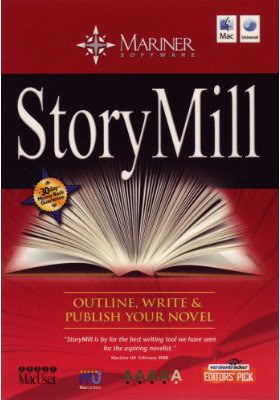
 I thought there might be some computing help out there to make my life easier. Microsoft Word is dismal when it comes to the demands of fiction writing. There’s no easy way to outline or to rearrange whole sections.
I started researching writing software for the Mac, reading reviews and comparing demo videos, and I settled on two that sounded promising — Scrivener and Copywrite — before a review for one of those led me to a third possibility — StoryMill. I looked at other options as well, but those three sounded like the best fit for the kind of writing I do, which is to say, novel-length fiction. Some other programs seemed to have more use for non-fiction writers or technical writing.
Intriguing features of these types of fiction-writing word processors (not available in all of them) are the ability to create timelines that link to your scenes, chapter views, the ability to save multiple revisions and revert to an earlier one if necessary, character description files, virtual corkboard for rearranging index cards that contain parts of the story, multiple windows to see various drafts simultaneously, inherent outlining, etc., and everything’s theoretically linked to everything else — so if you, say, moved a section on your corkboard, it would move that section in your novel as well, no tedious searching, cutting, and pasting necessary.
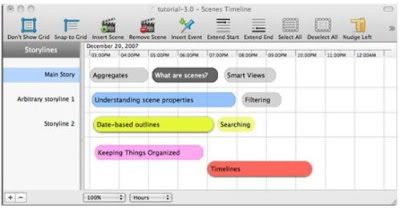
I have links from Amazon just for StoryMill
, so I went ahead and put up screen shots that were available to give a general idea of the sort of experience you’d have with one of these writers’ word processors.If you want to find out more about the programs, feel free to click on the software site links above or read some reviews for them here: CopyWrite reviews, Scrivener reviews, StoryMill reviews.
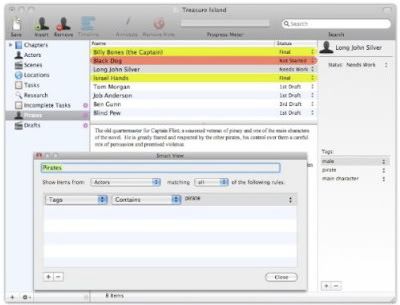
I won’t go into the details of each one, because ultimately I decided to hold off. It was when I was reading StoryMill reviews and one reviewer’s words really spoke to me:
May 15 2008 MSWWSM —
I can’t give this product any kind of fair review as I can’t quite figure out what it’s for. If I had to guess, I’d say this — and the similar Scrivener — are for writers who may indeed have the prose chops to get the job done but can’t get a handle on how to organize longer manuscripts in their heads …
Foremost, StoryMill and Scrivener are not models for how novelists I know actually work. We have various loose “processes”, we keep notes, we do research — not too little research on-the-fly, so to speak — and we may rough out in a notebook, on an index card, or on the back of the power bill, overarching plot lines, concepts, perhaps brief character sketches, snippets of especially pithy dialogue or metaphor we just have to use, that sort of thing. But everyone I know merely takes something that’s been stewing, sits down one morning, or evening, or dead in the middle of night, and begins writing; then we go back and eradicate, illuminate and, well, prevaricate, as required to make the story whole. …
As for aspiring novelists, screenwriters, playwrights, etc., I can’t help but advise you’d be far better off just sitting down and writing, ignoring the confusing disorganized mess you may create — because you CAN — and WILL, if you stick at it — develop a process for sorting things out, making sense of disparate parts and gluing them together into a coherent story. The bottom line is, called upon to take 60,000 - 120,000 words or more, vet this draft for grammar, style, continuity errors, etc., it’s never going to just wrap up nicely, and it’s always going to degrade into a brutal grind at times, whether you write on legal pads with a blunt pencil or with these sorts of computerized writers toolkits. It’s never easy, no matter what.
Emphasis mine, because man, oh, man.
Here’s a portion of the response from someone who liked the above review as much as I did:
although i am trying to write a novel with various timelines and therefore became interested in any computerized help i could get, i now am convinced that a dry erase board or a yellow pad with lots of revisions/erasures, as mswwsm notes, will work better.
a writer i admire once told an audience that when she teaches creative writing, she emphasizes B.I.C = butt in chair! there is no substitute and most of these apps are probably - at least for me - more of a distraction and an ill-fitted crutch than the solution and will probably never accomplish what mswwsm suggests. — rich ratzan
So, butt in chair, I have been doing the hard work.
I figured that spending any more energy than I already have on these software apps would just distract me from the task at hand. I would spend so much time copying my scenes into each demo version, then editing in each one to see how it works. I would type in character descriptions and obsess about details. It’s probably best just to use what I have and try to figure out a process for myself.
I think next time I write a novel, I will start off in one of these software options, to see if it helps. Ideally, I’ll start three novels simultaneously, so I can see which of the three options makes things easiest!
But for now — I have an outline of my original draft in OmniOutliner. I’ve rearranged it in the same app, checking my timeline by sketching it out with purple pen (hey, it was around) on the back of an envelope and drawing arrows to show which parts I wanted to change around or add.
I have another file in OmniOutliner for notes and revisions, which includes my character descriptions, painstakingly copied every time a character came up. Then I can make sure haircolor and age and the like don’t change throughout the story by referring back to my notes. I have listed things I want to add and things I want to change. I have ideas for place names and poisons. (Hey, it’s a murder mystery!) I chose OmniOutliner for this file, because I can indent subtopics to show that they relate to an above main topic, but also primarily because OmniOutliner offers little checkboxes all down the side. Whenever I’ve completed a revision task, I can check it off and stop worrying about it. Most of the boxes remain unchecked, but at least I know that they will get done, and I don’t have to keep it all in my head.
I’ve saved multiple drafts now in Word, and I’m going to start the annoyance of cutting and pasting according to my outline, and then … it’s rewrite time. I’ll just have to go in, read it through, and change what doesn’t make sense anymore. Which I’m assuming will be most of it. Sigh.
Butt in chair. I’ll get there.



 Bill Shapiro, the editor of
  I came across
  . The book is by Jeffrey Overstreet, and the article is by Annie Young Frisbie, titled "On Fantasy Fiction; Or, You Should Read Cyndere's Midnight."
 and the
  , and I hear true fantasy fans disparage them as bad examples of the genre, so...I guess I'm just not a fan, although this glowing review might inspire me to give it another chance. Truly, no offense intended; I think I just get tripped up by names I don't know how to pronounce.
 and
and  :
: -- sorry, Jane!).


 Back during the first season of Survivor, there was an endurance test toward the end where the remaining contestants had to keep their hand on a pole. That was the only rule. One of the contestants, good old Rudy, absentmindedly removed his hand from the pole to scracth his nose or something, and then tried to play it off, but was deservedly disqualified.
 subscribe to feed
 follow on twitter
 like on facebook


